Two villages, one spell in the Serra de Tramuntana
Valldemossa and Deià are barely 10 minutes apart by car, linked by the Ma-10 road that winds between the Serra de Tramuntana and the Mediterranean. They are, by far, Mallorca's two most photographed stone villages, and not by chance: Chopin lived here for an entire winter, Archduke Ludwig Salvator of Austria settled here after falling in love with the landscape, and Robert Graves wrote much of his work here. The result is genuine heritage — a charterhouse, palaces, writers' houses — wrapped in cobbled streets, olive terraces and tiny coves that make up for any steep climb.
Valldemossa: the Real Cartuja and the stone village
Valldemossa is built around the Real Cartuja, the former Carthusian monastery where Frédéric Chopin and the writer George Sand spent the winter of 1838-39, a stay he described as gruelling because of the cold and damp, and which she immortalised in 'A Winter in Mallorca'. Today the building can be visited inside: the monks' cells turned into exhibition rooms, the original pharmacy, the cell Chopin occupied with his piano and, with a separate ticket, the tower of the former Palace of King Sancho, with views over the whole valley.
Outside the Cartuja, wandering through the village is a big part of the plan: Carrer de Blanquerna, the square by the Church of Sant Bartomeu, the terraced flower bed and the stone façades with pots of geraniums that have made Valldemossa a constant postcard scene. It's worth heading down to Port de Valldemossa, a tiny cove with a handful of fishermen's houses and a small stream, very different from the bustle of the upper village.
Deià: the artists' village and Son Marroig
Deià is smaller and more vertical: stone houses stacked up the hillside, with the bell tower of the Church of Sant Joan Baptista overlooking the cemetery with sea views where Robert Graves is buried. The British writer lived here from the 1920s onwards, and his house, Ca N'Alluny, can be visited as a museum dedicated to his life and work. The whole village still breathes that bohemian past: art galleries, ceramics workshops and terraces where artists and musicians have kept settling for decades.
On the outskirts, on the way to Valldemossa, is Son Marroig, the former estate of Archduke Ludwig Salvator of Austria. It's visited as a house-museum, with its Italian-style marble viewpoint looking out over Sa Foradada, the peninsula with the characteristic hole in the rock that is one of the most recognisable sights of the Tramuntana.
Cala Deià, the beach that makes the climb worth it
Cala Deià is a pebble cove surrounded by cliffs, with a couple of simple beach bars and a relaxed atmosphere that draws locals and visitors alike from early on. Driving down means a narrow road with a small paid car park in season (April to October) that fills up fast in summer; the more comfortable option is to leave the car in the village and walk down the signposted path that starts on Carrer d'es Clot, next to the Refugi de Can Boi, a walk of about 30 minutes with views of the sea and mountains. Bus line 203 also runs from the Estació Intermodal in Palma to Deià.
How to get around between Palma, Valldemossa and Deià
The most flexible way to visit both villages is by car or on a guided tour that includes free time at each stop, since it lets you adjust the pace between the slopes of Valldemossa and the coves of Deià. For those who'd rather not drive the winding Ma-10, organised coach excursions from Palma cover the route with a photo stop at the Tramuntana viewpoints.
Full-day tour to Palma and ValldemossaCheck availability →
Bus tour with free time in Puerto de Sóller and ValldemossaCheck availability →The Sóller train, the area's classic excursion
Although the historic wooden train doesn't reach Valldemossa or Deià, Sóller is just a short hop from both villages along the Ma-10, and its famous century-old railway, which departs from Plaça d'Espanya in Palma, is one of the island's most popular excursions and can be combined with visiting both villages on the same day.
Hiking and nature in the Serra de Tramuntana
The entire stretch between Valldemossa and Deià is part of the Serra de Tramuntana, a Unesco World Heritage Site, with terraces of century-old olive trees, pine forests and viewpoints over the Mediterranean. For those wanting something more active than strolling the cobbled streets, there are guided hiking routes through the mountains that combine walking sections with local gastronomy, a different way of experiencing the landscape that drivers only see from the road.
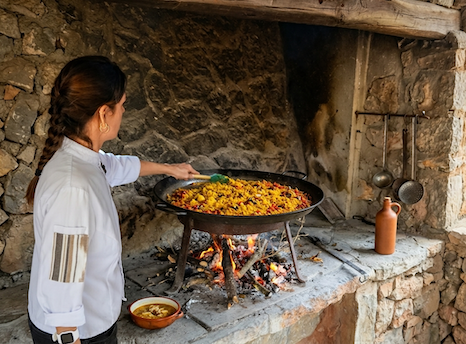
Serra de Tramuntana: Hiking experience & wood-fired paella in EsporlesCheck availability →When to go and practical tips
- Best time to go: spring and autumn, with mild temperatures for walking and fewer cars on the Ma-10 road.
- Parking: limited in both villages and at Cala Deià; arriving early or using the bus/an organised tour saves time spent looking for a spot.
- Comfortable footwear: the streets are cobbled and quite steep in both villages.
- Combining in one day: Valldemossa in the morning (the Cartuja), lunch in Deià and the afternoon at Cala Deià or Son Marroig is a classic, realistic route.
- Book Cartuja tickets in advance in high season, when tour groups can create queues.
Valldemossa and Deià aren't 'see it and tick it off the list' destinations: they're villages for walking slowly, sitting on a terrace with views over the valley and letting the rhythm of the Tramuntana set the pace of the day. Between the Cartuja, Son Marroig, Sa Foradada and Cala Deià there's heritage, sea and mountains all at once, something unusual even on an island as varied as Mallorca.