What to see in Alcúdia's old town
The starting point for exploring northern Mallorca is Alcúdia itself: a walled medieval core that can be explored on foot in a couple of hours and makes a perfect base for the rest of the area. Its almost intact 14th-century walls encircle an old town of cobbled streets, stately houses, the church of Sant Jaume and several historic gates such as the Portal del Moll and the Portal de Xara. Walking along the Camí de Ronda, the elevated walkway atop the wall itself, offers the best views over the rooftops and, on clear days, out over the bay.
The Ciutat Romana de Pol·lèntia, the north's archaeological gem
At the edge of the historic centre lies the Pol·lèntia site, the Roman city founded in 123 BC that gives the region its name. Visitors can explore the forum, the residential area of Sa Portella and the Roman theatre, one of the best preserved in Spain, carved directly out of the rock. Admission also includes the Museu Monogràfic, next to the church of Sant Jaume, which displays pieces recovered from the excavations: mosaics, sculptures and objects from everyday Roman life.
Port d'Alcúdia and the bay's coves, by boat
Port d'Alcúdia combines a lively seafront promenade, a marina and one of the island's longest, most family-friendly beaches, with fine sand and shallow waters. Most boat excursions to the bay's coves and up the north coast depart from here: it's the natural starting point for discovering this coastline from the sea, which is the best way to appreciate the contrast between the cliffs of the Serra de Tramuntana and the sandy coves tucked among the pine woods.
 Catamaran Cruise: Beach, chill & fun from AlcudiaCheck availability →
Cap de Formentor, the Mediterranean's most spectacular viewpoint
The Ma-2210 road that climbs from Port de Pollença up to the Formentor lighthouse is, for many, Mallorca's most beautiful scenic route: a winding series of bends between vertiginous cliffs with the sea below. The must-stop is the Mirador d'Es Colomer, 232 metres above sea level, with views of the Sierra del Cavall Bernat and the islet of the same name. Further on, close to the lighthouse, lies Formentor beach, with white sand and pine trees down to the shoreline, one of the most photogenic spots on the island.
 Discover Formentor by catamaran: Beach and sceneryCheck availability →
Playa de Muro and the Parc Natural de s'Albufera
Between Port d'Alcúdia and Can Picafort lies Platja de Muro, a several-kilometre stretch of fine sand backed by dunes and pine woods, much quieter than Alcúdia's seafront. Just behind it opens the Parc Natural de s'Albufera, the largest wetland in the Balearics: a mosaic of channels, reed beds and lagoons that is a must for birdwatchers, with more than 300 species recorded over the year. There are marked routes for walking and cycling, and several wooden hides along the way.
Coves de Campanet, the north underground
Just over twenty minutes' drive from Alcúdia, on the southern slope of the Tramuntana, the Coves de Campanet offer a roughly 40-minute tour through more than 500 metres of underground galleries with stalactites, stalagmites and a small interior lagoon. They are among the least crowded caves on the island and a good option on a hot day, since the temperature inside stays constant all year round.
 Admission tickets to the Caves of Campanet: Nature and MagicCheck availability →
Pollença and the inland villages of the north
Just a few minutes from Alcúdia, Pollença is well worth a stop in its own right: its arcaded main square, the Calvari (the staircase that climbs up to the hermitage with views over the bay) and the Sunday market in the historic centre. From the Puig de Maria, on the outskirts of the village, the whole plain down to the bay of Pollença comes into view. It pairs well with Formentor, since both lie along the same route, and with Sa Pobla or Muro, less touristy inland villages where agricultural Mallorca can still be felt.
Dolphins, jet skis and how to get around without a car
The bay of Alcúdia is also a good spot for dolphin watching, especially on early-morning outings, when the sea is calm and the pods are most active. For those travelling without a car, or who'd rather avoid Formentor's traffic restrictions in high season, the most convenient option is an organised bus tour combining Alcúdia's market with the drive up to the viewpoint and the lighthouse in a single day.
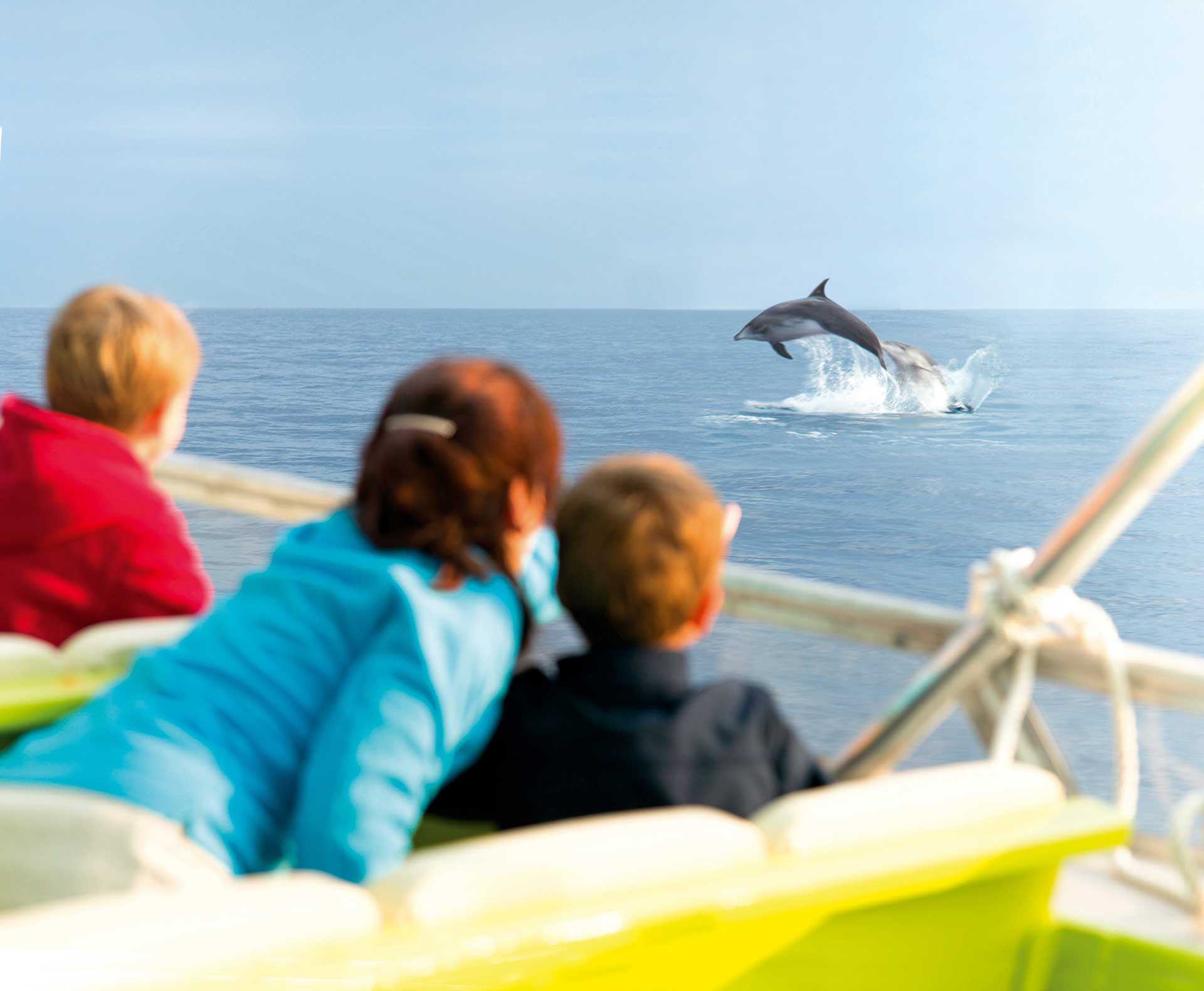 Witness the magic: Sunrise dolphin watching in Alcudia BayCheck availability →
 Bus tour: Alcudia Street Market & FormentorCheck availability →
When to go and how to plan the visit
Alcúdia and its surroundings can be enjoyed almost year-round: in high season (June to September) it's essential to get an early start for Formentor and to factor in the traffic restriction, while in spring and autumn the north can be explored at a more relaxed pace, with better conditions for walking around s'Albufera or climbing the Puig de Maria. In two or three days it's possible to combine the historic centre and Pol·lèntia, a boat trip around the bay, the drive up to Formentor and a side trip to the Coves de Campanet or Pollença, without rushing and without covering the same roads twice.